

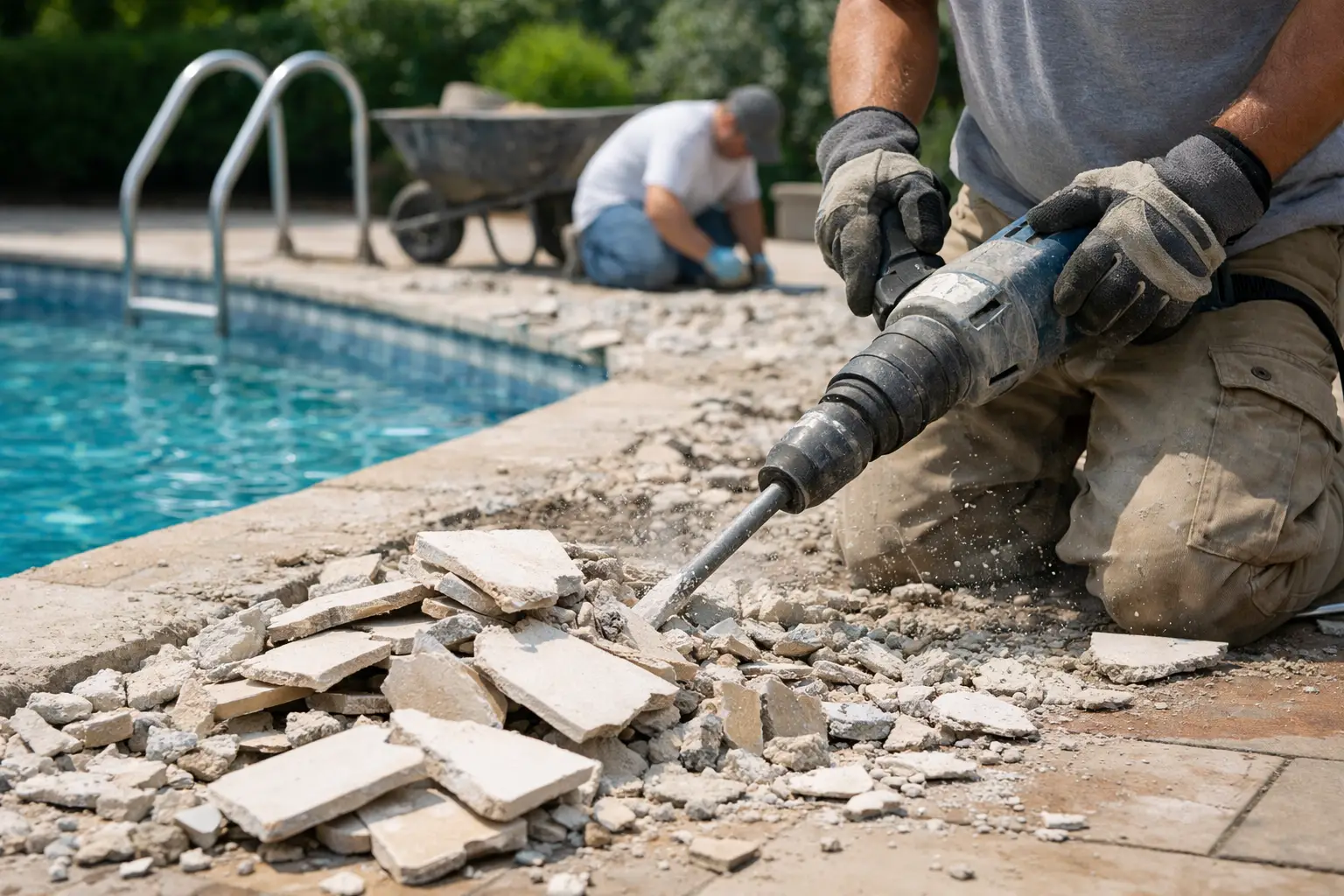
Pool & Decking Tile Removal done properly means less damage, less downtime and a cleaner site ready for repairs, resurfacing or new finishes.
Cracked coping, drummy tiles and stubborn bedding don’t just make a pool area look tired – they slow down the whole renovation. Pool & Decking Tile Removal needs to be done cleanly, safely and with the right equipment, especially when the goal is to leave the surface ready for waterproofing, repairs or new finishes without creating extra work for the next trade.
This is one of those jobs that looks simple until the first few tiles come up. Around pools and outdoor deck areas, tiles are often bonded hard, laid over ageing screeds, or sitting on substrates that have already seen movement, moisture and years of exposure. If the removal is rushed or handled with the wrong method, the result is usually damaged concrete, loose edges, leftover adhesive and a site that still isn’t ready for the next stage.
Why pool and decking tile removal is different
Pool zones are not like a standard internal floor. You’re dealing with water exposure, slip-rated surfaces, expansion and contraction, drainage falls, and in many cases a mix of materials across the same area. One section may be tiled over concrete, another over a mortar bed, and another tied into coping or surrounding paving.
That matters because removal has to be controlled. The goal isn’t just to get the tiles off. The goal is to remove tiles, bedding and adhesive in a way that protects the base where possible and clearly exposes any defects that need repair. On older sites, removal can reveal cracked screeds, failed waterproofing, hollow sections or movement in the slab. That’s not bad news – it’s useful information, but only if the area has been stripped back properly.
What a proper Pool & Decking Tile Removal job should achieve
A professional result means more than broken tiles in a skip. The surface should be stripped back far enough for the next step to happen without delays. That could mean new tiling, resurfacing, membrane work, coping replacement or a broader outdoor renovation.
On a well-managed job, the area is assessed first for tile type, bond strength, access, drainage points, edge conditions and likely substrate issues. From there, the removal method is matched to the job. Some areas need mechanical chipping. Others need more controlled work around pool edges, steps, channels or adjoining finishes that are staying in place.
After the tiles are lifted, the remaining adhesive or bedding usually needs to come off as well. This is where many jobs fall over. If residue is left behind, the next installer is forced to work over an uneven or contaminated base. That affects bond, levels and finish quality. Proper surface preparation is what separates a fast strip-out from a complete one.
Common problems uncovered during tile removal
It’s common to find more than old tiles underneath. Outdoor and pool surrounds often hide problems that only show up once the surface is removed.
The most frequent issues are cracked substrates, loose mortar beds, moisture damage, failed previous repairs and inconsistent levels. In some cases, the tile failure was never the real problem. It was just the visible sign of movement or water ingress below. Removing everything cleanly allows those issues to be identified early, before new materials go down.
That saves time later. It also avoids the all-too-common scenario where a new finish is installed over a poor base and starts failing again far too soon.
Dust, mess and site disruption
Any demolition-style removal work creates noise, debris and dust, but it should still be controlled. Around homes, unit complexes, hotels or commercial outdoor areas, that matters. A sloppy strip-out can affect nearby rooms, neighbouring properties and the broader renovation schedule.
That’s why dust control, containment and clean execution are part of the job, not optional extras. The site should be managed so waste is removed efficiently, work zones are kept safe and surrounding surfaces are protected where required. For clients trying to keep a renovation moving, clean removal is often just as important as fast removal.
When speed matters
Most clients booking pool or decking tile removal are already on a timeline. Water proofers, tilers, concreters and landscapers are booked next. Delays at removal stage ripple through the whole project.
A specialist team can usually move much faster than a general demolition crew because the work is more targeted. The right machinery, the right attachments and experience with hard-bonded surfaces all make a difference. So does knowing when to shift from heavy mechanical removal to finer detail work around vulnerable edges and fixtures.
For homeowners and builders across Northern NSW, the Gold Coast, Brisbane and the Sunshine Coast, that practical speed matters most when the end result is a site that is actually ready – not half-stripped and waiting on more prep.
Choosing the right team for pool and decking tile removal
If you’re comparing contractors, look past whether they can remove tiles. Ask whether they can remove the full system cleanly, manage difficult substrates, control dust and leave the area ready for the next trade. That’s the real measure of the job.
This kind of work rewards experience. Pool surrounds and outdoor deck areas can turn technical very quickly, especially when there are signs of moisture damage, previous patching or multiple layers of old material. You want a team that works with urgency, but not at the expense of the slab, the falls or the final finish.
Rapid Stripped handles these jobs the way they should be handled – with the right prep, the right removal method and a clear focus on leaving the site clean, safe and ready for what comes next. If the pool area is being renovated, repaired or completely resurfaced, getting the removal done properly is what keeps the rest of the project moving.